| ELECTRICTY COMES TO REACH |
|
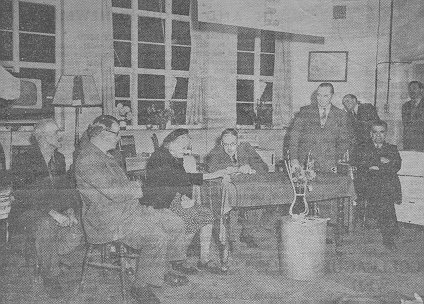
Oldest Resident Switches On Village Supply Reach's oldest inhabitant, 84 year old Mrs. Badcock, switched on the villages electricity supply on Friday evening. "This is a great day in the history of Reach, Mr, B. Day, of the Parish Council, said to the, enthusiastic audience which packed the School to overflowing. Mr. Day went on to describe earlier, methods of illumination through the centuries: . . . a faggot burning on the hearth; a bit of (tried moss burning in an earthenware bowl of fat); rush lights and composite candles; then oil lamps, and cookers; and now electricity?" He then called on Lieut Col A.E. Knights, Fens sub area manager of the Eastern Electricity Board. "These functions are some of the most pleasant duties, I am called upon to perform", said Lieut Col. Knights before asking Mrs. B. Badcock to switch on for the first time in Reach. Then Mrs. Badcock leaned across the, table in the lamplight and pulled the switch. The lights blazed on and a six foot sign of red, white and blue bulbs above the table glowed 'Welcome to E.E.B'. The dramatic moment was fully appreciated. |
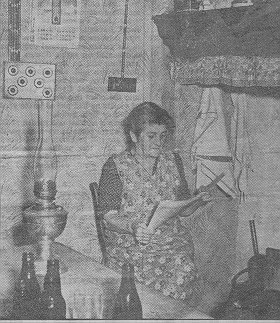 |
Top-Mrs. Badcock swithcing on. Others in the photograph are (from left to right) Mr. Badcock, Mr. Forrester, Mr. Day, Col. Knights and Mr. Holiday. Below-The former scene in the White House, the landlady of which is seen reading by oil-lamp light. |
A PROGRAMME AND A PROMISE KEPT. Resuming his speech, Lieut Col. Knights said that the supplying of power to Reach was part of the Eastern Electricity Board's ten year programme. Only these who have lived by candlelight and lamplight fully realised the blessing of electricity. The Board was glad of the opportunity of selling "service". It was essentially a service and this had to be paid for by revenue and trading It was only the combination of resources which enables this work to be done "I am extremely pleased," he said in conclusion "to have carried out tonight a promise I made to the Parish Council three years ago. Lieut Col. Knights then invited anyone with any difficulty or query to get into touch with Mr. A. Forrester, the manager of the Newmarket Branch, or one of his assistants. "Mr. Forrester, he added, runs an extremely efficient service he has a reputation for it." Mr. Forrester spoke next. telling, of the months of work by the engineers, linesmen, electricians and representatives of the Board which had culminated in the switch on, "There are" he said, "some one hundred premises in Reach and we have received orders to connect about 80, which is most gratifying. M r Holiday, of the Consultative Electricity Council spoke of the watching brief held by his Council over the consumer's interests and said that there were fewer complaints in this particular sub area than in any of other. This was a matter for congratulation. At the end of the ceremony a bouquet of chrysanthemums was presented to Mrs. Badcock by Mr. Forrester. He then invited the gathering to view the exhibition of electrical appliances which the Board had provided. RESPONSE AND INTEREST It was some time before movement was possible, so tightly were the. people packed into the available sitting and standing space. They had turned out in force in response. to the Board's invitation, "Never have I known such a switching on!" said the Board's photographer and he has seen plenty! Great interest was shown in the appliances on view in particularly the television which the Board's radio engineer had installed. A large number stayed to watch televised circus programme until 9.45 p.m. Many left the ceremony to go home and find their houses brightly lit by electricity. And others went. to the hostelries across the green to celebrate the event in the traditional way. NO ORDINARY VILLAGE Reach, 'Reek, Recke, as it has been variously called, is no ordinary village. It is a tight knit community taking great pride. in Reach's ancient history. There the older folk will tell you of the great Fair and hundreds of horses; of frost floods and the hosts of wildfowl on the Fen, of long ago. They will tell you of the Roman settlement and of King John signing the charter with the Burgesses of Cambridge that they should have their Fair in Rogation week. And they will tell you proudly 'They say ....this was once a city!". Possibly the earliest record of Reach was in 1070. It was William the Conqueror storming, into this hamlet at the end of the Devil's Dyke and burning it to the ground, 1070 a figure in a book, but it was fire, and pillage in the land. It was part of England in the forging. Even before then Reach must have been of importance. It is thought that because Reach, like cities, was given the figure of a cathedral on the old maps, there may have been an Anglo Saxon bishoprie there. This would account for the legend of the city. But it is not known: the history is lost in the mists of the Dark Ages. FACE OF REACH CHANGES AGAIN So, through the centuries, the buildings have. risen and fallen. The Roman villa; the huts of the Dark Ages; houses of Saxon times, all are gone. A few, relics of the middle years remain and relics of the hay day of Reach when it was an inland port. And a gay and thriving place it must have been in the, great days of the Fair. The. old houses that once, were pubs The Ship, The Cabin The Bull must have done a roaring trade. The Black Eyed Susan, down by the Hythe, must have been a snug berth for the waterman after the long journey from Lynn; and French brandy and Hollands' schnapps must have vied with English ale in the, lamplit evenings. But even at its zenith there never was more cheerful noise, and wassail than there was in the Black Swan on the night of Friday, November 13th, 1953. And now the lamplight is going. The houses are brilliant with electric light; electric cookers stand in the kitchens; and the television aerials are going up. Household tasks are lightened and daily habits alter. The face of ancient Reach is changing once again; and the talk is now of kilowatts and cathode rays. It might seem to be the development of an ordinary small village of a mere few hundred years foothold: the clues to its antiquity are not so obvious. But for those who listen closely, the 'Proud tradition persists, the legend lingers on "This . . . was once a city." Independant Press and Chronicle Friday November 20th 1953 |